
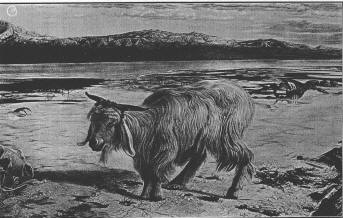
What is the atonement for sin described in Leviticus 16 and how can killing an animal cover our soul’s sin?
The biblical idea of sacrifice is the notion of finding an acceptable substitute for the sinner which would be cursed by bearing the sins of the sinner and then be offered as a blood sacrifice to atone or erase the sins in order that the sinner could “approach” God.
The Day of Atonement’s (Yom Kippur) sacrificial ritual from the Torah is described in Leviticus 16:5-10:
“And from the Israelite community he shall take two he-goats for a sin offering and a ram for a burnt offering. (Note: these goats were to be identical as to come from the same source, to be adequate for atonement of sins therefore without blemish).
16:6. Aaron is to offer his own bull of sin offering, to make expiation for himself and for his household.
16:7. Aaron shall take the two he-goats and let them stand before the LORD at the entrance of the Tent of Meeting;
16:8. and he shall place lots upon the two goats, one marked for the LORD and the other marked for Azazel.
16:9. Aaron shall bring forward the goat designated by lot for the LORD, which he is to offer as a sin offering;
16:10. while the goat designated by lot for Azazel shall be left standing alive before the LORD, to make expiation with it and to send it off to the wilderness for Azazel.
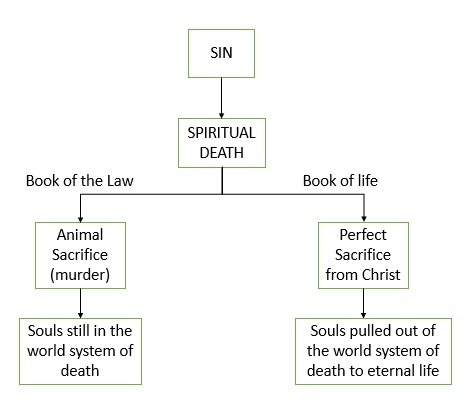
It is important to note that the Book of the Law’s ritual regarding the covering of sins through animal sacrifice did not actually save souls by freeing them from the consequences of sin which is spiritual death but rather provided a reminder to the people that sin incurred the death penalty while also providing a form of psychological relief to allow people to continue living without the weight of their sins on their conscience. After all an animal born in the world cannot be a fit sacrifice unless God declares it so and the animal cannot volunteer its life therefore this would not represent a sacrifice but simply the killing of an animal. It was however a ritual meant to foreshadow the spiritual work God would do to save the souls once they realized they could never be truly righteous in the flesh as the flesh itself was sinful by keeping the soul away from God (read the blog What is Sin?). The Book of the Law establishes what God expects from us but it does not provide a way to save us out of the sin we inherit when we are simply born in the flesh not to mention everything we accumulate thereafter.
The Old Testament or the Tanakh which includes the Book of the Law (the Torah) teaches souls through experience what happens when they choose to serve the world and other gods (created beings, objects or fallen angels). In the scriptures, God does not prevent souls from making other choices but rather, just as a parent would do with a child, He warns and teaches by way of the consequences or lessons resulting from those choices. The Old Testament also describes and perhaps more importantly, the purification process that each soul must undergo once it becomes one of God’s People. For example, the Elect were to be God’s spiritual Firstfruits as they were the first ones to pray to the one Living God. They were liberated from their slavery, spent 40 years in the wilderness – a period of sifting and testing, before arriving to the promised land. This foreshadows the spiritual work that must be done on each soul by the Holy Spirit before it can go to the “Promised Land”. Every book in the Old Testament provides practical examples and lessons regarding this purification process but one must read between the lines. Further, after being baptized and the Holy Spirit descending upon Him, Jesus fasted for 40 days in the desert during which time Satan sought to lead Him astray.
Zechariah 13: 8-9 “In the whole land, declares the Lord, two thirds shall be cut off and perish, and one third shall be left alive. And I will put this third into the fire, and refine them as one refines silver, and test them as gold is tested. They will call upon my name, and I will answer them. I will say, ‘They are my people’; and they will say, ‘The Lord is my God.’”
While the Book of the Law deals with the purification process of the soul through experience while in the flesh body but it does not provide mercy for the soul after physical death rather, it provides a judgement of spiritual death as a consequence of sin. This is important to understand to the extent that it announces the true work of salvation God promises and which occurs later through the sacrifice of Jesus Christ, the Messiah.
John 6: 44-51 – “No one can come to me unless the Father who sent me draws them, and I will raise them up at the last day. It is written in the Prophets: ‘They will all be taught by God.’ Everyone who has heard the Father and learned from him comes to me. No one has seen the Father except the one who is from God; only he has seen the Father. Very truly I tell you, the one who believes has eternal life. I am the bread of life. Your ancestors ate the manna in the wilderness, yet they died. But here is the bread that comes down from heaven, which anyone may eat and not die. I am the living bread that came down from heaven. Whoever eats this bread will live forever. This bread is my flesh, which I will give for the life of the world.”
John 3: 12-15 – “If I have told you earthly things and you do not believe, how can you believe if I tell you heavenly things? No one has ascended into heaven except he who descended from heaven, the Son of Man. And as Moses lifted up the serpent in the wilderness, so must the Son of Man be lifted up, that whoever believes in him may have eternal life.“
Luke 9:24 – “For whoever would save his life will lose it, but whoever loses his life for my sake will save it.”
Romans 8: 1-8 – “Therefore, there is now no condemnation for those who are in Christ Jesus, because through Christ Jesus the law of the Spirit who gives life has set you free from the law of sin and death. For what the law was powerless to do because it was weakened by the flesh, God did by sending his own Son in the likeness of sinful flesh to be a sin offering. And so he condemned sin in the flesh, in order that the righteous requirement of the law might be fully met in us, who do not live according to the flesh but according to the Spirit.
Those who live according to the flesh have their minds set on what the flesh desires; but those who live in accordance with the Spirit have their minds set on what the Spirit desires. The mind governed by the flesh is death, but the mind governed by the Spirit is life and peace. The mind governed by the flesh is hostile to God; it does not submit to God’s law, nor can it do so. Those who are in the realm of the flesh cannot please God.”
The practice of animal sacrifice in the Book of the Law was meant to atone for sins by signifying repentance with a view to justifying the flesh in the eyes of God by meeting the requirements of the Law thereby protecting a sinner from the consequences of their sins (i.e.: to save the flesh).
The sacrifice of Jesus Christ to atone for the sins of those sinners who recognize Him as the Messiah, whether Elect or Gentile, justifies the soul of all sins in the eyes of God, setting it free from the world and the Law of spiritual death for sin. Through Christ’s sacrifice, a way was made for repentant souls to exit the legal system of the world and return home. Christ’s sacrifice represented the first goat in Leviticus 16 which is designated by lot (see here the drawing by lot between Barabbas and Jesus) for the LORD and is put to death as a sin offering to save sinners.
With respect to the second goat, the goat for Azazel, I have read many texts and opinions on what it represents but disagree with most of them so far. This goat is meant to be kept alive and released in the desert never to return to the area from which it came, carrying with it the sins of sinners. Some believe that Christ fulfilled both goat sacrifices 2000 years ago on the cross however the second goat is meant to stay alive and never return whereas Jesus Christ will return at the second coming. Many articles tend to focus on Azazel insinuating that since a goat is sacrificed for the Lord, by reciprocity principle one should be sacrificed for Azazel, an interpretation I disagree with. I believe focusing more on Azazel’s role in the process of purification of the souls leading to the repentance of souls, keeping in mind that Azazel represents the wilderness, a place of hardship or isolation, would provide more insight on the Azazel references in Leviticus 16:8-10.
In Revelation 12:6, the bride is sent into the wilderness (Blue Letter Bible -biblical usage: a place of isolation, loneliness or where one is deserted by others, deprived of the aid and protection of friends, acquaintances, kindred), for a period of 3 ½ years. After this period of testing, the bride is taken up to meet her Bridegroom (Jesus Christ) in the air (Rapture) for the wedding day.
1 Thessalonians 4:16-17 – “For the Lord Himself will descend from heaven with a shout, with the voice of the archangel and with the trumpet of God, and the dead in Christ will rise first. Then we who are alive and remain will be caught up together with them in the clouds to meet the Lord in the air, and so we shall always be with the Lord.”
Scriptures do not indicate that the bride ever returns to the world after the rapture. However, on Judgement Day, Christ returns in His Father’s glory with His angels (the armies of heaven) and then leaves the world never to return again after His Millennium reign is over and the judgement of the dead has taken place. It would appear then that the Bride and the Bridegroom together fulfill the goat for Azazel requirement, the bride leaving earlier while her bridegroom follows later. Considering both the bride and the bridegroom as one sacrificial goat embodying the goat for Azazel also aligns with God’s view on marriage where both the bride and the bridegroom become one.
Matthew 19:4-6 – “Haven’t you read,” he replied, “that at the beginning the Creator ‘made them male and female,’ and said, ‘For this reason a man will leave his father and mother and be united to his wife, and the two will become one flesh’? So they are no longer two, but one flesh. Therefore what God has joined together, let no one separate.”
This is even truer of the union of the soul to Jesus Christ since it is the result of the Holy Spirit calling the soul and bringing “her” to her bridegroom for the wedding – a spiritual union. This is most definitely a union that God has ordained and that nobody is allowed to separate.
While Jesus is currently gathering all his future brides (the believers), prior to Judgement Day, many of the unbelievers (the remnant of the Elect and the Gentiles) will repent and recognize Jesus Christ as the Messiah (thereby washing their robes – Revelation 7:14) during the tribulation period. Jesus already indicated that He would gather them as well into His fold.
John 10:14-16
“I am the good shepherd; I know my sheep and my sheep know me— just as the Father knows me and I know the Father—and I lay down my life for the sheep. I have other sheep that are not of this sheep pen. I must bring them also. They too will listen to my voice, and there shall be one flock and one shepherd.”
The idea that the bride plays a part in fulfilling the goat for Azazel requirement to atone for the sins of the Gentiles (the unbelievers) in the end times is also supported by Isaiah 54 in the KJV which states that the bride will inherit the Gentiles.
Isaiah 54:1-6 Sing, O barren, thou that didst not bear; break forth into singing, and cry aloud, thou that didst not travail with child: for more are the children of the desolate than the children of the married wife, saith the Lord. 2 Enlarge the place of thy tent, and let them stretch forth the curtains of thine habitations: spare not, lengthen thy cords, and strengthen thy stakes; 3 For thou shalt break forth on the right hand and on the left; and thy seed shall inherit the Gentiles, and make the desolate cities to be inhabited. 4 Fear not; for thou shalt not be ashamed: neither be thou confounded; for thou shalt not be put to shame: for thou shalt forget the shame of thy youth, and shalt not remember the reproach of thy widowhood any more. 5 For thy Maker is thine husband; the Lord of hosts is his name; and thy Redeemer the Holy One of Israel; The God of the whole earth shall he be called. 6 For the Lord hath called thee as a woman forsaken and grieved in spirit, and a wife of youth, when thou wast refused, saith thy God.
Since Azazel is a personification of the sin introduced to mankind, he essentially rules over lost souls. Azazel dwells in the wilderness and the sacrificial goat for Azazel is left alive in front of the Lord before being sent away in the wilderness, carrying with it the sins of the community, never to return again. I do not believe this second goat is meant to cover the same group of people as that covered by the first goat which covers the sins of the Believers who already recognized Christ as the Messiah and I do not believe that it is a sacrifice made for Azazel or Satan.
We see here that time plays a role in the atonement process, that is to say, there is an emphasis that underlines the moment when the soul accepted Christ as its Messiah, before the tribulation period or after? Before the tribulation period the sins of souls are atoned for by the sacrifice of Jesus Christ alone while after the beginning of the tribulation the sins are atoned for by Jesus Christ and the Bride (believers already raptured to heaven or His Firstfruits). This does not make the second atonement any less significant and according to Scriptures, these souls are also invited to the wedding supper – This discrepancy does however provide more information on the soul purification process.
Further, while some priests used to kill the goat for Azazel once it was in the desert to ensure it would not return to the community bringing back the sins of the community with it, the Word of God states that the goat is to be a living sacrifice sent to the wilderness never to return again. This is important as Jesus taught His disciples to become living sacrifices – more on this topic below.
Here is an overview of Leviticus 16 from BibleTools.com by David C. Grabbe:
“The two goats of the unique Day of Atonement ceremony are first mentioned in Leviticus 16:5, which contains an often-overlooked detail: “And he shall take from the congregation of the children of Israel two kids of the goats as a sin offering, and one ram as a burnt offering.
The “two kids of the goats” together are a single sin offering. That is, the two young goats are distinct elements that jointly accomplish this offering for sin; both parts are absolutely required for the offering to be accepted. A typical sin offering consists of only one animal, but this sin offering consists of two. This shows that something additional is being accomplished here, something beyond just the payment for sin.
The biblical sin offering, detailed in Leviticus 4, is God’s prescribed way to show sins being paid for through a death. While “it is not possible that the blood of bulls and goats could take away sins” (Hebrews 10:4), God still required blood to be shed to remind the people that sin incurs the death penalty.
A critical part of the sin offering involves the priest placing his hands on the head of the animal before it was slain to show that the animal would stand in the place of the party under judgment. The unblemished, innocent animal, representing the guilty party, symbolically received the guilt. This detail is reiterated four times within the instructions for the sin offering (Leviticus 4:4, 15, 24, 29), as well as in the initial consecration ceremony for Aaron and his sons (Exodus 29:10). A sin offering is incomplete without this symbolic transference taking place.
Every sacrificial animal—through the requirement of it being unblemished—is portrayed as being sinless (Deuteronomy 17:1; Leviticus 22:17-25). The Pentateuch contains at least forty injunctions that the sacrificial animals, either in specific offerings or in general, had to be without blemish or defect. In addition, Malachi 1:6-14 records God’s indignation at later priests for offering blind, maimed, and diseased animals. A reason the animals had to be of the highest quality is that they were offered to God, who deserves only the best. A second reason is that every sacrificial animal prefigured the Savior, who was entirely without blemish or defect.”
In the symbolism of a substitutionary sacrifice, an innocent participant is chosen to bear the sins of the guilty. However, this utterly fails to apply to Satan, for his millennia of sin make it impossible for him to be pictured as unblemished or innocent. Not by any means!”
END TIMES SACRIFICE
As mentioned, I believe Jesus fulfilled the first sacrifice, the sin offering sacrifice for the Lord which opened a door out of the world system for all souls who repent and accept His sacrifice to atone for their sins. He will be returning for the remnant of the Elect who rejected Him previously and for the Gentiles who will recognize Him as the Messiah at the end of the 7-year tribulation period therefore He cannot be considered to have already fulfilled the living sacrifice represented by the second goat for Azazel which is meant to leave and never return.
The fact that the carrying out of the second goat sacrifice is postponed until the end times is no different from the prophetic passage under Isaiah 61:2 as read by Jesus in Luke 4:16-21 where He confirmed that He would fulfill this whole passage up to and including the proclamation of the new Jubilee and then stopped short of including the last part concerning the day of vengeance, insinuating that He would fulfill the day of vengeance at a later date – – read the blog JESUS CHRIST, THE ALPHA, THE OMEGA AND EVERYTHING IN BETWEEN
Isaiah 51:1-2 (prophetic text)
“The Spirit of the Sovereign Lord is on me, because the Lord has anointed me to proclaim good news to the poor.
He has sent me to bind up the brokenhearted, to proclaim freedom for the captives and release from darkness for the prisoners,
to proclaim the year of the Lord’s favor and the day of vengeance of our God, to comfort all who mourn “
Luke 4: 16-19
“And he came to Nazareth, where he had been brought up. And as was his custom, he went to the synagogue on the Sabbath day, and he stood up to read. And the scroll of the prophet Isaiah was given to him. He unrolled the scroll and found the place where it was written,
“The Spirit of the Lord is upon me, because he has anointed me to proclaim good news to the poor. He has sent me to proclaim liberty to the captives and recovering of sight to the blind, to set at liberty those who are oppressed, to proclaim the year of the Lord’s favor.”
LIVING SACRIFICES
Since all sinners who accept Christ’s atoning sacrifice for their sins are redeemed and justified of their sins, they are all made to be acceptable sacrifices, unblemished, reborn through the Holy Spirit and the blood of Christ thereby becoming one with Christ. This fulfills the requirement that both goats be unblemished and that both come from the congregation of the children of Israel. The newly redeemed are grafted into the Olive Tree or the Vine that is Christ and therefore become members of the congregation of the children of Israel. As followers of Jesus Christ, we are all asked to become “living sacrifices” and to become “one” with Christ.
Jesus calls all those who wish to follow Him to forgive their enemies and pray for those who persecute them in order to take upon themselves the sins of others which is also the meaning of carrying one’s cross. He asks them to become living sacrifices and to make believers of all Nations (the term Nations in the bible refers to the Gentiles, the unbelievers) and to do all of this without getting entangled in the affairs of this world, before being caught up to Heaven. This is the exact description of the goat for Azazel, a living sacrificial goat who takes upon itself the sins of others and is to leave and never return again to the place where it came from (i.e.: the world). Further, born-again souls are in the world but are separate from it spiritually therefore they are already isolated or circumcised spiritually-speaking from the world prior to being taken away out of the world – they are in the world but not of it.
Matthew 16: 24-25: “Then said Jesus unto his disciples, if any man will come after me, let him deny himself, and take up his cross, and follow me. For whosoever will save his life shall lose it: and whosoever will lose his life for my sake shall find it.”
Romans 12:1 – “I appeal to you therefore, brothers, by the mercies of God, to present your bodies as a living sacrifice, holy and acceptable to God, which is your spiritual worship.”
Hence, I believe the second part of the Leviticus 16 atonement sacrifice, the living sacrifice for Azazel, will be fulfilled in the end times by both the bride and the bridegroom. In the end times, Jesus returns for the day of vengeance – the day of judgement – as the conquering Lion of Judah representing justice. At that time, we will see Justice and Mercy working hand in hand – Mercy provided by the goat for Azazel to atone for the sins of the unbelievers who repent during the tribulation period and Justice, when God’s judgement is unleashed.
The judgement of Babylon in Revelation 18: 21-24 states:
“Then a mighty angel picked up a boulder the size of a large millstone and threw it into the sea, and said: ‘With such violence the great city of Babylon will be thrown down, never to be found again. The music of harpists and musicians, pipers and trumpeters, will never be heard in you again. No worker of any trade will ever be found in you again. The sound of a millstone will never be heard in you again. The light of a lamp will never shine in you again. The voice of bridegroom and bride will never be heard in you again. Your merchants were the world’s important people. By your magic spell all the nations were led astray. In her was found the blood of prophets and of God’s holy people, of all who have been slaughtered on the earth.’”
As living sacrifices, we are called to die to self for our fallen soldiers in this world, for the lost or sleeping souls and for those who simply didn’t make it because the trials got the better of them. We must take our focus off our own suffering and the actions of the people around us who are largely controlled by the forces of the Adversary and rather, think about all the captive souls wherever they may be.
We are all sparks of God with the potential to become children of God once more, we are all interconnected like a fishing net, to each other and to the source of all life, our Creator.
John 12: 23-26: “Jesus replied, “The hour has come for the Son of Man to be glorified. Very truly I tell you, unless a kernel of wheat falls to the ground and dies, it remains only a single seed. But if it dies, it produces many seeds. Anyone who loves their life will lose it, while anyone who hates their life in this world will keep it for eternal life. Whoever serves me must follow me; and where I am, my servant also will be. My Father will honor the one who serves me.”
In summary, all those who follow Christ become archetypes of living sacrifices or the goat for the unrepentant, goats for Azazel. With respect to the stated source of the said goat having to come from the “congregation of the children of Israel” as per Leviticus 16, I cover this in the “The new Adam and the new Eves” blog as well but as mentioned above essentially, followers of Christ are reborn through the blood of Christ and the Holy Spirit thereby becoming new grafted branches on the Olive Tree (the Vine that is Christ), even though they were previously wild olive branches strewn about. In other words, they have become part of the spiritual lineage of Jesus Christ. They are then of the same source and become acceptable unblemished sacrifices.
Before performing the first sacrifice for the elect (the Olive Tree) and then leaving this world, Jesus taught His disciples to become living sacrifices. This was likely to prepare His disciples to accomplish the second part of the Leviticus 16 sacrificial ritual to atone for the sins of the remnant of the Elect and the Gentiles who will be grafted to the Olive Tree. By doing this, He ensured that the requirements of the Law would be fulfilled such that all the souls could eventually be freed. We work with Christ to ensure this end.
| Previous blog JESUS CHRIST, THE ALPHA, THE OMEGA AND EVERYTHING IN BETWEEN | Next blog THE NEW ADAM AND THE NEW EVES |
 Follow the Vine Official Blog Site